
Views: 0 Author: Site Editor Publish Time: 2026-11-10 Origin: Site


Factory floors and mining pits are no places for fragile tech. As industrial operations push artificial intelligence out of server rooms and directly onto the front lines, the hardware gap becomes glaringly obvious. A standard consumer-grade device simply cannot survive the rigorous physical demands of an active assembly line or a subterranean mining shaft. This environment demands robust engineering.
This is precisely where a specialized Rugged Android Tablet becomes a non-negotiable asset. By blending high-performance computing capabilities with military-grade physical durability, these devices act as the primary backbone for deploying AI-driven diagnostics and real-time data analytics. Hardware failure in these extreme conditions translates directly to operational downtime and severe financial loss. Consequently, adopting specialized computing platforms ensures that critical software remains functional and reliable regardless of external environmental stressors.
Edge AI Readiness: Moving artificial intelligence to local devices requires specialized hardware. A durable tablet serves as the optimal edge computing platform, enabling organizations to run latency-sensitive models directly on the device without relying on continuous internet connectivity.
Durability Meets Innovation: Consumer electronics are not engineered for industrial hazards. Integrating IP-rated water and dust resistance with extreme temperature tolerance prevents costly hardware failures.
Industry Transformation: The combination of localized AI and durable hardware objectively optimizes complex workflows. From real-time defect detection in manufacturing to predictive maintenance in logistics, these devices serve as the physical interface for advanced analytics.
Strategic Selection Criteria: Procuring the correct hardware requires evaluating specific technical parameters. Decision-makers must analyze processing power, memory configurations, battery lifecycle management, and environmental certifications to ensure alignment with deployment goals.
Recent market analyses highlight a massive paradigm shift toward decentralized computing across heavy industries. Driven by global supply chain pressures and Industry 4.0 initiatives, the manufacturing and logistics sectors are aggressively pushing AI to the edge. The goal is straightforward—eliminate bandwidth bottlenecks and enhance data security. Historically, AI applications relied heavily on continuous internet connectivity to transmit raw data to cloud servers. However, latency-sensitive tasks cannot afford the milliseconds lost during transmission. Executing real-time computer vision on a fast-moving assembly line requires hardware capable of computing complex algorithms directly in the field, even in dead zones with zero network coverage.
When deploying edge AI, the operating system dictates scalability. The open-source architecture of Android presents a distinct advantage for enterprise deployment. Unlike restrictive proprietary systems, Android provides developers with the necessary flexibility to integrate custom machine learning models directly into the hardware. Through optimized frameworks like TensorFlow Lite, IT departments can tailor the software environment strictly to their operational bottlenecks. This flexibility accelerates the time-to-market for new enterprise initiatives.
In practical terms, the most sophisticated AI model is entirely useless if the hardware running it shatters from a minor drop. Preventing device failure directly correlates to AI uptime. When field technicians wearing heavy, grease-stained gloves can trust their equipment to survive harsh conditions, they experience fewer interruptions. This baseline reliability transforms the tablet from a simple communication tool into a continuous productivity multiplier.
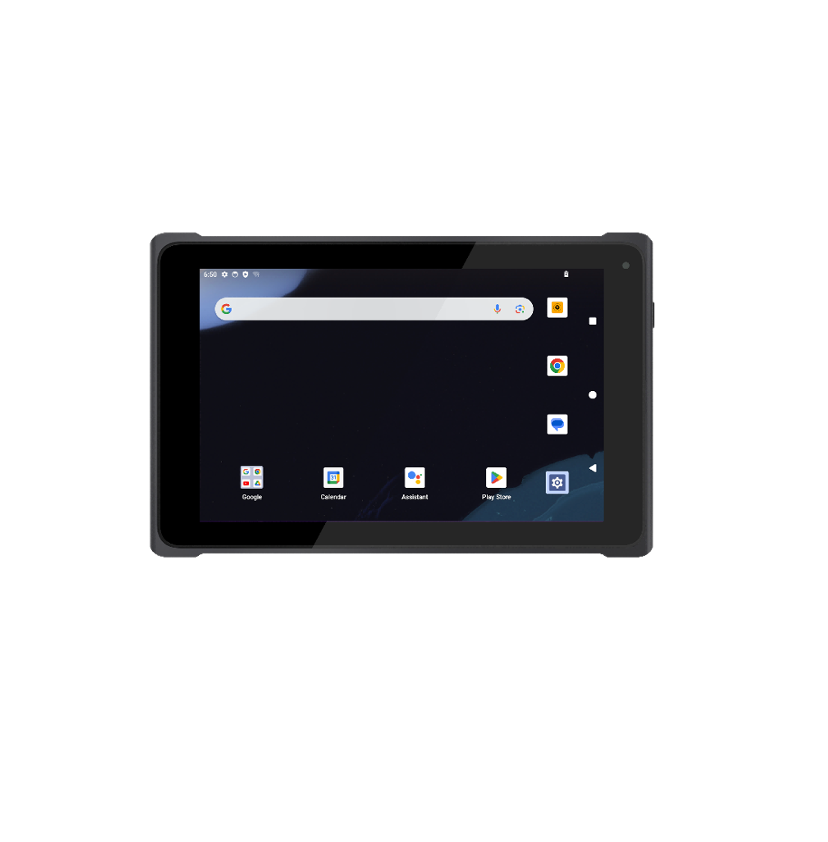
Running complex neural networks locally requires significantly more computational power than standard enterprise applications. Decision-makers must evaluate specific internal specifications to ensure the hardware can handle sustained inference workloads without thermal throttling.
The central processing unit alone is no longer sufficient for advanced machine learning tasks. Modern industrial AI requires robust multi-core architectures. Local AI inference demands rapid access to large datasets and model parameters. Insufficient memory will cause the system to bottleneck, resulting in delayed processing times. For industrial applications, an 8GB RAM paired with a 128GB ROM configuration is the professional baseline. High read and write speeds allow the device to cache datasets and load neural network weights instantaneously.
Even with edge processing, these devices must eventually synchronize with centralized enterprise systems to aggregate broader insights. Seamless connectivity is non-negotiable. Devices must support modern protocols, including Dual-band Wi-Fi for dense factory environments, 4G LTE for remote field operations, and Bluetooth 5.2 for low-latency communication with external peripheral sensors.
Specification Category | Consumer-Grade Tablet | Industrial Rugged AI Tablet | Impact on AI Operations |
|---|---|---|---|
Processing Architecture | Standard CPU architecture | Octa-core processor with AI optimization | Faster local AI inference with lower battery drain. |
Memory Capacity | 4GB RAM / 64GB ROM | 8GB RAM / 128GB ROM | Prevents system crashing during heavy data loads. |
Operating Temperature | 0°C to 35°C | -20°C to 60°C | Reliable AI data processing in extreme environments. |
The theoretical benefits of edge computing are best understood through practical applications. In heavy industry, the integration of durable hardware and machine learning is fundamentally altering standard operating procedures.
Quality assurance has traditionally relied on human inspection, which is susceptible to fatigue. By utilizing the high-resolution cameras embedded in a high-performance Rugged Android Tablet, manufacturers can deploy computer vision models directly on the assembly line. As products pass by, the tablet captures images, processes them through a local neural network, and identifies microscopic defects in milliseconds. The system instantly triggers an alert to halt the production line.
Unplanned machinery downtime is a massive financial drain in the manufacturing sector. Predictive maintenance utilizes AI to analyze data from machinery and forecast failures before they occur. Industrial tablets serve as the central hub for this process. Workers connect the tablet to external vibration sensors via Bluetooth. The local AI model aggregates this data, comparing current machine vibrations against historical failure models to alert technicians of impending mechanical degradation.
The term rugged is often tossed around as a marketing buzzword. However, in the context of industrial hardware, it refers to specific, quantifiable engineering standards. Understanding these certifications is crucial for calculating the true return on investment.
The two most critical durability benchmarks are MIL-STD-810G standards and Ingress Protection ratings. Specifically, an IP67 rating indicates the device is completely sealed against fine particulate dust and can survive submersion in water. For environments like mining or outdoor logistics, these metrics provide empirical assurance of longevity. The device can survive repeated drops onto concrete from 1.2 meters without internal component failure.
Field service technicians frequently operate outdoors. A standard screen turns into a dark mirror under direct sunlight, rendering the software useless. Industrial tablets utilize 8-inch high-brightness IPS displays, typically reaching 800 nits, combined with anti-glare treatments. Furthermore, advanced digitizers allow for glove-touch and wet-touch capabilities, ensuring workers can interact with AI interfaces in the pouring rain.
AI processing is inherently power-intensive. Running continuous computer vision models will rapidly deplete a standard lithium-ion battery. For operations that run non-stop, equipping the workforce with an 8-inch slim rugged Android tablet featuring an 8500mAh high-capacity battery ensures seamless shift transitions. This engineering feature allows a worker to complete a full 10-hour shift without interrupting an active AI diagnostic process.
While proprietary systems have their places in the enterprise ecosystem, Android has emerged as the dominant operating system for mobile edge AI deployments. This dominance is driven by objective technical advantages.
Industrial workflows rarely rely on a tablet alone. Workers need to interface with a wide array of peripherals, including RFID readers, thermal imaging modules, and specialized IoT sensors. The Android ecosystem offers unparalleled hardware compatibility. Manufacturers build devices with modular expansion ports that allow these peripherals to plug directly into the tablet seamlessly.
Managing a fleet of thousands of devices across multiple geographic locations requires robust oversight. Android Enterprise provides deep APIs that allow IT administrators to control devices remotely through Mobile Device Management solutions. IT teams can push AI model updates over-the-air, enforce strict security policies, and lock down devices to specific applications simultaneously.
Investing in specialized industrial hardware requires a higher initial capital expenditure compared to purchasing off-the-shelf consumer devices. However, enterprise procurement must be evaluated through the lens of Total Cost of Ownership.
Consumer-grade tablets deployed in harsh environments typically experience a massive failure rate within the first year. This necessitates a constant cycle of repairing and replacing devices. Ruggedized devices are engineered for a lifecycle of three to five years. By drastically reducing the replacement rate, the higher upfront cost is amortized over a longer period, resulting in substantial long-term capital savings.
The true cost of a broken device is not the price of the hardware. It is the cost of the resulting operational downtime. If a worker cannot access their predictive maintenance application because their tablet shattered, the machinery they are monitoring may fail. This leads to thousands of dollars in lost production per hour. Rugged durability ensures that AI-driven insights are consistently available.
Selecting the appropriate hardware requires a rigorous evaluation of your specific operational environment. Decision-makers must catalog the extremes their equipment will face. Will the device operate in sub-zero freezer warehouses? Will it be mounted to a forklift experiencing continuous low-frequency vibration? Matching the hardware IP and MIL-STD ratings to these specific environmental stressors is the foundational step.
Balancing a lightweight form factor with uncompromising industrial performance is critical for user adoption. A prime example of this engineering balance is the 8-Slim Rugged Android Tablet T89. It provides the necessary 8GB RAM processing framework to run localized edge AI applications while maintaining the IP67 environmental certifications required to survive continuous deployment in the toughest sectors.
The deployment of Artificial Intelligence in industrial settings is no longer a futuristic luxury. It is a competitive necessity. Enterprise software is only as strong as the physical hardware that runs it. By investing in high-performance rugged computing platforms, organizations ensure that their AI tools remain operational in the most hostile environments. This strategic choice maximizes uptime, reduces total cost of ownership, and drives continuous business decisions. For engineering teams looking to future-proof their operations, selecting the right durable hardware from trusted manufacturers like Vincanwo Group provides an unshakable foundation for sustainable digital transformation.
A: While they may theoretically load the same basic software, consumer tablets fundamentally lack the specialized thermal cooling, high-capacity battery management, and environmental protection required to handle the sustained computational loads of industrial AI tasks. They will frequently overheat or fail entirely under industrial conditions.
A: Look primarily for a robust multi-core processor paired with sufficient memory, typically 8GB of RAM. This combination is strictly necessary to handle complex machine learning data inference locally without slowing down the device or rapidly draining the battery.
A: Modern engineering has resolved historical weight and bulk issues. Contemporary slim series devices have significantly reduced overall weight profiles without sacrificing structural integrity. This makes them highly ergonomic and ideal for all-day field usage by technicians.
A: Rugged devices are specifically engineered for longevity and typically feature a much longer operational lifecycle of 3 to 5 years compared to standard consumer devices. This extended lifecycle provides a significantly better total cost of ownership and requires far fewer disruptive hardware updates.
A: While both are durable, a true industrial tablet features specific enterprise-level integrations. This includes modular expansion ports for barcode scanners, pogo pins for secure vehicle mounting, and specialized wide-temperature batteries designed for extreme industrial environments rather than just basic drop protection.
A: Edge AI works by downloading a compressed, pre-trained machine learning model directly onto the tablet storage. When the tablet camera or sensors capture new data, the local processor analyzes that data through the model instantly, making decisions without ever needing to send the information back to a cloud server.


