
Views: 0 Author: Site Editor Publish Time: 2026-11-05 Origin: Site


Modern manufacturing relies heavily on flawless data integration and continuous operation. Picture a fully automated facility. Precision robotic arms move in perfect synchronization. Continuous data streams from the shop floor to overarching management software. Assembly lines operate at breakneck speeds. In this high-stakes environment, equipment reliability is absolutely non-negotiable. Yet, a critical bottleneck often emerges. Bridging the gap between sophisticated software algorithms and heavy physical machinery remains a massive engineering challenge.
Standard commercial computers might function perfectly in climate-controlled offices. However, they quickly succumb to the harsh realities of a factory floor. Microscopic metallic dust, oily mist, and continuous mechanical vibrations inevitably compromise traditional active cooling systems. When a fan fails, thermal throttling begins immediately. Catastrophic motherboard short-circuits follow close behind. The ultimate result is exorbitant unplanned downtime and missed production quotas.
Recent market analyses highlight a massive paradigm shift in the manufacturing sector. The industry is rapidly transitioning toward Edge AI and decentralized control. Factories no longer rely solely on distant cloud servers to process operational data. Cloud processing introduces unacceptable latency for real-time automation. Instead, modern facilities deploy ruggedized edge devices directly at the machine level. This trend underscores the absolute necessity for local hardware capable of surviving the physical environment. These edge nodes must execute complex machine vision and predictive maintenance algorithms instantly without failure.
To navigate this digital shift, facility managers increasingly turn to purpose-built hardware. Industrial-grade Fanless Touchscreen Computers serve as the ultimate problem-solvers in these scenarios. By eliminating moving parts and providing an intuitive human-machine interface, these ruggedized units act as the interactive backbone of automated environments. This comprehensive guide explores the mechanics, core benefits, and essential purchasing criteria for industrial computing. We will help you select the exact hardware needed to keep your production lines moving seamlessly.
Ultimate Reliability: Passive cooling architectures completely remove the risk of mechanical fan failure. They also prevent hazardous dust buildup inside the chassis.
Harsh Environment Ready: Purpose-built to resist extreme temperature fluctuations, sudden shocks, and the constant vibration of heavy machinery.
Seamless Interaction: These specialized units act as intuitive interface hubs. Operators can monitor and adjust real-time machine data effortlessly.
Lower Total Cost of Ownership: Drastically reduced maintenance requirements and extended hardware lifespans yield a superior long-term Return on Investment.
Strategic Hardware Selection: Deploying true industrial-grade devices ensures stable integration with modern factory automation protocols and legacy systems alike.
Tracing the history of industrial computing reveals a landscape marked by trial and error. In the early days of automation, factories attempted to rely on standard desktop PCs. They used these fragile machines to manage nascent digital workflows. Designed for pristine office desks, these computers were violently out of place next to stamping presses and welding robots. Accumulated debris and extreme heat proved fatal to consumer-grade components. This mismatch caused massive production gaps that cost manufacturers dearly.
To combat these environmental hazards, engineers pioneered the shift to passive cooling. Instead of pulling ambient air through the system with fans, fanless technology utilizes internal copper heat pipes and heavy-duty aluminum alloy enclosures. The entire metal chassis functions as a massive heat radiator. It dissipates thermal energy naturally into the surrounding air. By completely removing moving mechanical parts, the hardware becomes effectively immune to the most common causes of PC failure.
Building on this thermal foundation, the evolution naturally progressed toward integrated interfaces. Automation requires a localized brain that human operators can interact with quickly and safely. This necessity gave rise to all-in-one computing solutions. By combining robust processing power with a ruggedized display in a single sealed housing, facilities eliminated the need for fragile external peripherals like mice and keyboards. Such accessories are entirely impractical in messy industrial zones.
Dust and Debris Immunity
Factory floors are inherently contaminated spaces. They are often filled with airborne metallic shavings, sawdust, or chemical powders. A standard PC acts like a vacuum cleaner. It pulls this hazardous air directly across sensitive microchips. This inevitably causes short circuits. In contrast, fanless designs are hermetically sealed. Without ventilation holes for air intake, microscopic debris is physically blocked from entering the motherboard chamber. This ensures uninterrupted logic processing.
Shock and Vibration Resistance
Manufacturing equipment generates relentless kinetic energy. When a massive CNC lathe or hydraulic press operates, the resulting vibrations can literally shake traditional hard drives to pieces. The read and write heads crash into the spinning platters. To counter this, rugged Fanless Touchscreen Computers utilize solid-state drives and cable-less internal architectures. Components are soldered directly to the board. This secures the data link even during high-intensity operations.
Wide Temperature Operations
Commercial electronics typically falter when exposed to significant temperature swings. They suffer from condensation or thermal shutdown. Industrial units are engineered with wide-temperature components. They operate flawlessly across a broad thermal spectrum. Whether mounted in a sub-zero cold storage warehouse or positioned mere feet from a high-heat foundry furnace, the processing integrity remains uncompromised.
Silent Operation and Compact Footprint
Beyond physical durability, the absence of cooling fans results in completely silent operation. This is a subtle but significant ergonomic benefit that helps reduce overall noise pollution on the factory floor. Furthermore, their compact footprint allows them to be easily integrated into tight spaces. They can be mounted on swivel arms or embedded directly into machine control cabinets without obstructing worker movement.
Injecting Soul into the Robotics Industry
Robotic arms and automated guided vehicles require split-second timing. They demand robust local processing power. A fanless PC acts as the central neurological node for these systems. It processes visual feedback from three-dimensional cameras and manages safety sensor arrays. This ensures that multi-axis robots move smoothly and safely without logic errors or network latency delays.
CNC Machining Integration
For CNC operators, data clarity and immediacy are paramount. Mounting a specialized industrial panel PC directly onto the machine chassis transforms the workflow. Machinists can load complex CAD and CAM files, monitor tool wear, and adjust cutting parameters instantly. This localized control drastically reduces the time workers waste walking back and forth between active machines and a centralized control room.
Assembly Line and Conveyor Belt Management
The lifeblood of automation is continuous data flow. Positioned at strategic intervals along an assembly line, these computers serve as critical supervisory control nodes. They monitor conveyor belt speeds and track raw material inventory via RFID scanners. They instantly flag production bottlenecks. They act as the vital bridge between frontline sensors and overarching factory management software.
Selecting the appropriate hardware for a fully automated facility is a critical engineering decision. It directly impacts operational continuity. Procurement teams must look beyond basic spec sheets. You must evaluate long-term reliability and the manufacturer track record. Choosing a vendor that provides strict revision control and true industrial-grade components is essential. Repackaged commercial parts in metal boxes will inevitably cause software incompatibilities down the line.
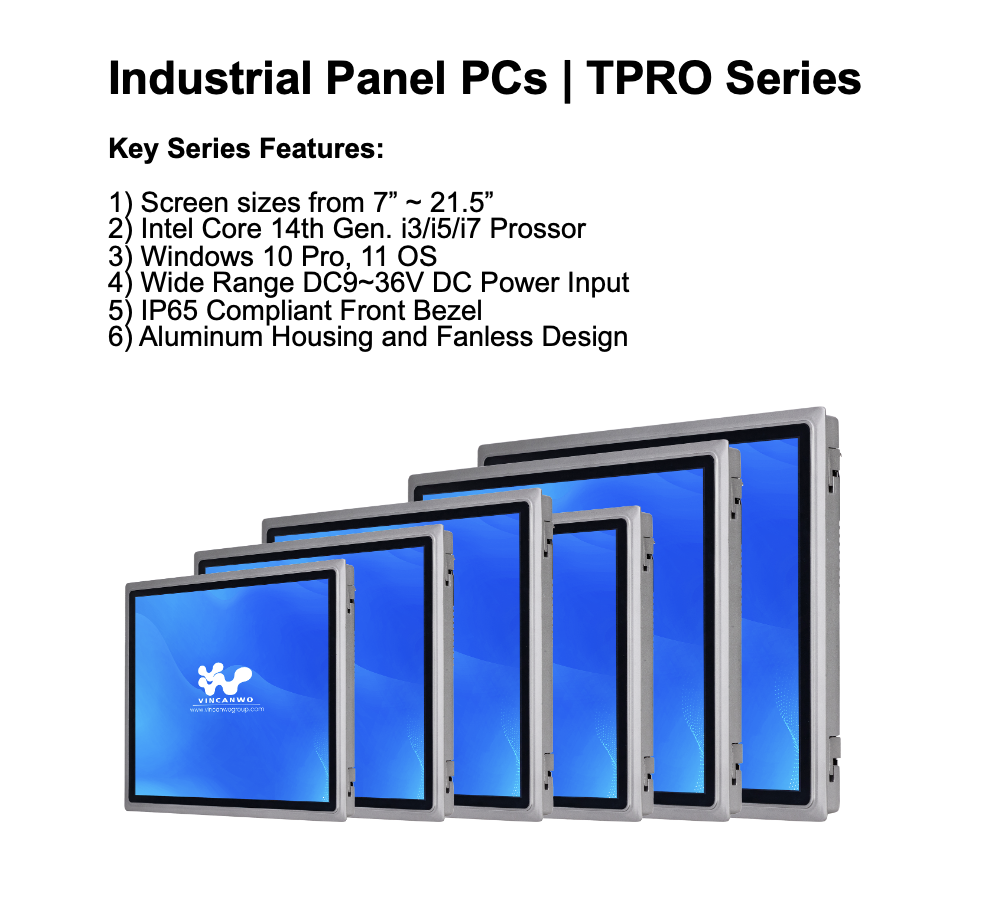
When evaluating specialized hardware, examining field-tested solutions provides valuable clarity. A prime example of this engineering philosophy is found in the Fanless Touchscreen Computers of the TPRO-X86 Series by Vincanwo Group. This platform is purpose-built to address the specific pain points of factory automation. It balances raw processing power with a deeply ruggedized exterior.
Ingress Protection Ratings
Procurement teams must verify the Ingress Protection rating. A minimum of IP65 is highly recommended for the front panel. Specifically, the TPRO-X86 series features a true IP65-rated seamless flat bezel. This ensures the unit is fully sealed against low-pressure liquid splashes and complete dust ingress. In specialized sectors like food processing, where equipment undergoes rigorous daily washdowns with pressurized chemicals, this waterproof sealing is a strict regulatory necessity.
Responsive and Rugged Touch Technology
The interface must match the working conditions. The TPRO-X86 series offers flexible touch options tailored to specific environments. Resistive touchscreens are highly durable and rely on physical pressure. They are ideal for environments where operators wear heavy leather work gloves or where the screen might be covered in oil. In addition, advanced projected capacitive screens offer multi-touch functionality similar to a smartphone. They can be factory-calibrated to penetrate through thinner latex gloves and resist water droplets.
Rich I/O Connectivity and Legacy Support
Modern automation relies heavily on high-speed Ethernet. However, the reality of most factory floors is a blend of new and old technology. It is crucial to select a computer equipped with a diverse array of ports. The TPRO-X86 architecture provides extensive connectivity, including dual Gigabit LAN, multiple USB ports, and critical legacy COM ports like RS232 and RS485. This ensures the new PC can seamlessly interface with both cutting-edge optical sensors and decades-old Programmable Logic Controllers.
Uncompromising Processing Architecture
The TPRO-X86 series excels because of its robust Intel x86 architecture. This ensures broad, native compatibility with standard industrial software ecosystems. Whether a facility utilizes Windows 10 IoT Enterprise for its network or a customized Linux distribution for a proprietary Manufacturing Execution System, the hardware provides stable foundational support. Coupled with its heavy-duty aluminum alloy enclosure that maximizes thermal dissipation, the system is engineered specifically for continuous reliability.
Feature and Specification | Standard Commercial PC | Industrial Fanless Panel PC | Impact on Factory Automation |
|---|---|---|---|
Cooling Mechanism | Active Internal Fans | Passive Aluminum Heatsink | Eliminates mechanical fan failures and prevents hazardous dust ingress. |
Enclosure Material | Plastic or thin sheet metal | Heavy-duty Aluminum Alloy | Provides high resistance to physical impact, shock, and vibration. |
Ingress Protection | IP20 at best | IP65 or IP67 Front Bezel | Allows safe operation in wet, dusty, or chemically harsh washdown conditions. |
I/O Connectivity | USB, HDMI, standard LAN | Dual LAN, multiple COM, GPIO | Enables seamless data integration with legacy PLCs and modern IoT sensors. |
Lifecycle Support | 1 to 2 years | 5 to 7 plus years | Dramatically reduces the frequency of hardware replacement and system recertification. |
Mounting Options
Deployment flexibility is key to factory integration. Panel mounting is the preferred method for embedding the unit directly into existing machine enclosures. This creates a flush, seamless look. VESA mounting provides versatility for attaching the computer to articulated swing arms or wall brackets. This allows operators to adjust the viewing angle easily. For electrical cabinets, DIN-rail mounting offers a standardized, secure way to install compact box PCs alongside other control gear.
Power Supply Considerations
Industrial power grids are notoriously unstable. When heavy machinery powers up, it often causes massive voltage spikes or sudden brownouts. These fluctuations would instantly fry a standard computer power supply. To mitigate this, select a system featuring a wide-voltage DC input. High-end industrial units typically support a 9V to 36V range. This built-in over-voltage and surge protection acts as a buffer. It ensures the motherboard receives a steady, clean flow of power regardless of grid fluctuations.
Best Practices for Deployment
Even the most rugged hardware requires thoughtful installation. Keep data and power cables meticulously organized and shielded from moving mechanical parts. Crucially, while passive cooling systems do not require internal fans, the external aluminum fins still rely on natural convection to dissipate heat. Avoid installing these units in completely airtight, unventilated boxes without accounting for ambient thermal transfer. The heat must have somewhere to escape.
Preventing Costly Downtime
When calculating the Return on Investment for factory infrastructure, the initial purchase price represents only a fraction of the Total Cost of Ownership. In fully automated environments, the most severe financial risk is unplanned downtime. A halted production line can easily result in thousands of dollars lost per minute. By isolating sensitive electronics from airborne contaminants and eliminating moving parts, fanless systems drastically reduce the probability of sudden hardware failure. This safeguards the facility revenue stream and delivery schedules.
Maintenance Savings and IT Budget Optimization
Actively cooled computers require exhausting, repetitive maintenance. IT personnel must routinely power down machinery, open PC chassis, and manually vacuum out accumulated debris to prevent overheating. Fanless computers operate on a highly efficient install-and-forget paradigm. This near-zero maintenance requirement allows IT departments to reallocate their valuable labor hours. They can shift focus away from routine hardware troubleshooting toward strategic initiatives like network cybersecurity and process optimization.
Future-Proofing for Next-Generation Manufacturing
As manufacturing evolves toward human-centric automation and advanced artificial intelligence, facilities will increasingly rely on heavy local data processing. Investing in high-performance fanless systems today prepares a factory for these inevitable future integrations. By deploying robust hardware with ample computational headroom now, factory managers ensure their infrastructure can seamlessly handle the predictive maintenance algorithms and machine vision software upgrades of tomorrow.
Because they lack moving parts and are hermetically sealed against environmental hazards, fanless industrial computers typically last five to seven years in continuous operation. Often, they last significantly longer. The elimination of mechanical fans removes the most common point of hardware failure. In stark contrast, a standard commercial PC deployed in a harsh factory setting might experience thermal degradation or dust-induced short circuits within mere months. This leads to a drastically shorter lifespan and disruptive replacement cycles.
No, they do not overheat when deployed correctly, even under intensive processing loads. These systems are engineered with advanced passive thermal management architectures. Instead of relying on airflow from fans, they utilize heavy-duty extruded aluminum chassis and internal copper heat pipes. This design effectively draws thermal energy away from the central processing unit and dissipates it across the large surface area of the external fins. This prevents the system from thermal throttling.
Yes. Industrial touchscreen interfaces are specifically calibrated to accommodate the realities of the factory floor. This includes the mandatory use of personal protective equipment. Many of these units are equipped with resistive touchscreens. These register inputs based on physical pressure rather than electrical conductivity. This makes them perfectly responsive to thick leather work gloves. Alternatively, advanced projected capacitive screens can be adjusted to increase sensitivity for use with thinner industrial gloves and in wet conditions.
Most x86-based fanless industrial PCs are architecturally identical to standard computers at the core level. This means they support a vast array of standard operating systems. They are fully compatible with industrial versions of Windows, such as Windows 10 and Windows 11 IoT Enterprise. These offer long-term servicing channels ideal for factory stability. Additionally, they seamlessly support multiple Linux distributions, ensuring broad compatibility with existing factory management software.
Actually, they are designed specifically to bridge the gap between modern IT networks and legacy operational technology. Unlike consumer PCs that only feature basic USB ports, industrial fanless computers are equipped with rich, specialized interfaces. They typically include multiple legacy serial ports like RS232, RS422, and RS485. These are absolutely essential for communicating directly with older Programmable Logic Controllers, CNC machines, and raw data sensors. This makes integration highly straightforward.
Modern industrial automation increasingly relies on Edge AI for real-time quality inspection and predictive maintenance. Fanless computers address this by integrating high-performance processors and dedicated AI accelerators within their passively cooled chassis. By processing data locally at the machine level, they eliminate the latency associated with cloud computing. The heavy-duty thermal design ensures that even when running complex machine vision algorithms continuously, the system remains stable without overheating.
An industrial panel PC is an all-in-one solution that combines the computing hardware and a rugged touchscreen display into a single unit. This design is perfect for human-machine interface applications where operators need to interact with the software directly. A box PC, on the other hand, is a standalone computing unit without a built-in screen. Box PCs are typically mounted inside electrical control cabinets and are used purely for background data processing, routing, or machine control where direct operator interaction is not required.
Achieving a truly automated, highly efficient factory is practically impossible without a foundation of deeply reliable hardware. These specialized industrial computers serve as the critical connective tissue between intelligent software and physical manufacturing machinery. Upgrading to passive cooling architectures dramatically improves operational efficiency while mitigating the risks of environmental damage.
Ultimately, transitioning away from fragile commercial PCs is a strategic investment in workplace safety, continuous production, and long-term profitability. Do not wait for a catastrophic hardware failure to halt your assembly line. Upgrade your factory floor infrastructure today. Explore the rugged, high-performance Fanless Touchscreen Computers by Vincanwo Group. By evaluating their comprehensive lineup, you can find the exact technological fit tailored to your specific automation demands and secure the future of your manufacturing operations.


