
Views: 0 Author: Site Editor Publish Time: 2026-03-24 Origin: Site


Many technology buyers assume that cooling fans automatically mean better heat control. In controlled office environments that assumption may hold true, but industrial environments follow very different rules. Dust, vibration, sealed cabinets, and continuous operation create conditions where traditional airflow-based cooling can actually become a weakness rather than a strength. Rugged Edge Computers designed with fanless thermal architecture address these challenges by prioritizing stability and reliability rather than simply moving air faster. Vincanwo Group, a Chinese industrial computing manufacturer with global export experience since 2008, develops industrial platforms specifically engineered to maintain stable performance in harsh environments where thermal stress, dust exposure, and long operating cycles are everyday realities.
Traditional IT servers are typically installed in climate-controlled rooms with stable airflow and carefully managed temperature levels. Data centers and office server rooms maintain predictable cooling conditions through dedicated HVAC systems. Industrial edge deployments rarely enjoy this luxury.
Edge computers are frequently installed directly inside equipment cabinets, control panels, vehicles, or outdoor enclosures. These spaces may have very limited airflow. Some cabinets remain sealed to protect electronics from environmental contamination, which further reduces natural heat dissipation.
Under these circumstances, cooling strategies that depend heavily on airflow become far less effective. When airflow is restricted, systems relying on fans may struggle to maintain stable temperatures over long operating periods.
Industrial heat challenges rarely occur alone. Instead, they combine with other environmental stresses that influence system reliability.
Heat plus dust is one of the most common combinations. Factories, warehouses, and production plants often generate airborne particles from raw materials or mechanical processes. When cooling systems draw air through a device, dust enters with it and accumulates inside.
Heat plus vibration is another concern. Equipment installed near motors, conveyors, or heavy machinery experiences constant vibration. Moving components such as cooling fans are particularly vulnerable to mechanical wear under these conditions.
Heat plus sealed cabinets further complicates thermal design. Industrial control cabinets often protect equipment from contaminants but limit airflow, creating warmer internal conditions.
Heat plus continuous operation is also significant. Industrial computers frequently operate 24 hours a day without interruption, meaning that thermal stability must be maintained for extended periods rather than occasional workloads.
These combined stresses explain why thermal management becomes one of the most critical design considerations for industrial edge computing systems.
Cooling technologies generally fall into two categories: active cooling and passive cooling. Active cooling uses fans or blowers to circulate air through the device, transferring heat away from internal components. Passive cooling, by contrast, relies on heat conduction and natural convection rather than forced airflow.
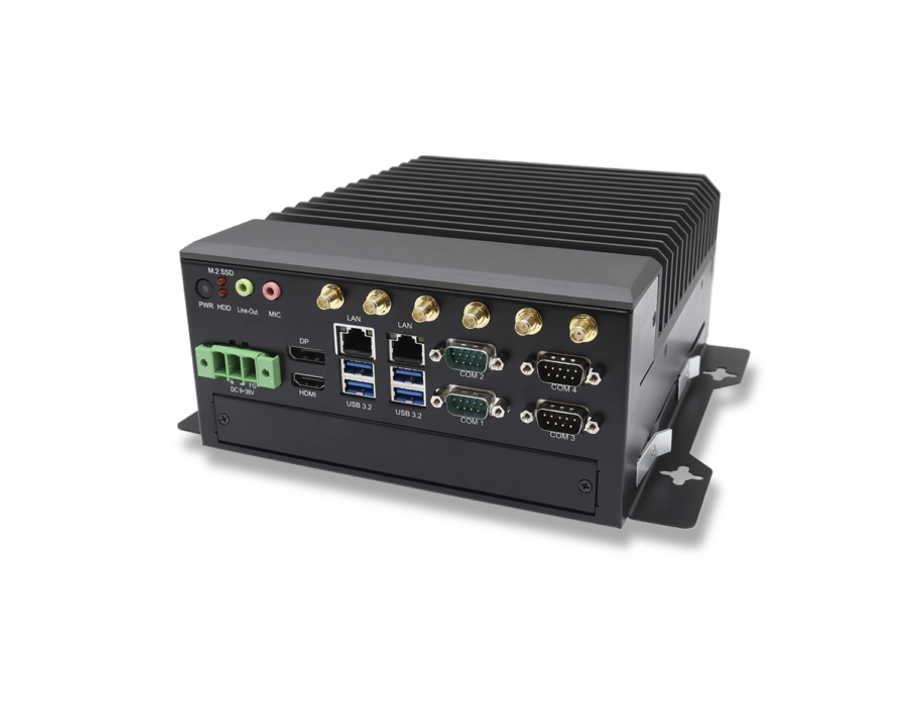
Fanless rugged edge computers use passive cooling techniques. Heat generated by processors and other components is transferred through heat spreaders into large metal heat sinks integrated into the chassis.
The external enclosure itself becomes part of the thermal system, dissipating heat through its surface area.
Effective passive cooling requires careful engineering. Heat sinks must be precisely designed to distribute thermal energy efficiently across the chassis. Materials such as aluminum are commonly used because they conduct heat effectively while remaining lightweight and durable.
Internal conduction paths connect heat-generating components directly to the outer structure of the device. These paths ensure that heat flows quickly away from sensitive electronics and toward the enclosure surface.
The external casing then radiates heat into the surrounding environment. Because this process does not rely on moving parts, it remains stable even when airflow conditions are limited.
One aspect that often surprises new users is that fanless industrial computers may feel warm or even hot to the touch. This is not a sign of malfunction. Instead, it indicates that heat is being successfully transferred from internal components to the external chassis.
In passive cooling systems, the enclosure acts as a heat radiator. As heat spreads across the metal housing, it dissipates naturally into the surrounding air.
This design ensures that critical internal components remain within safe temperature limits even when the external surface becomes warm.
Fans are mechanical components that experience wear over time. Bearings degrade, dust accumulates, and vibration can shorten lifespan. When a cooling fan fails, the entire system may quickly overheat.
Fanless industrial computers eliminate this vulnerability. With no moving cooling parts, there is one less component that can fail.
This design significantly improves long-term reliability, particularly in environments where maintenance access is limited.
Active cooling systems draw air through ventilation openings. Along with that air comes dust, fibers, and other airborne contaminants.
Over time, these particles accumulate inside the system. Dust buildup can block airflow paths, insulate heat-producing components, and increase internal temperatures.
Fanless designs avoid this problem because they do not pull external air into the device. The sealed enclosure prevents contaminants from entering the system.
This approach is especially valuable in factories, warehouses, and industrial plants where airborne particles are common.
Industrial installations often include outdoor infrastructure such as traffic monitoring systems, energy distribution cabinets, or transportation equipment.
These locations expose computing hardware to dust, moisture, and temperature fluctuations. Fanless systems provide greater resilience because their cooling strategy does not depend on external airflow conditions.
Similarly, factory floors with machining processes or raw material handling can generate substantial airborne debris. Fanless computing platforms are better suited for such environments.
Thermal stability depends heavily on the electronic components used within the system. Industrial-grade processors, memory modules, and storage devices are selected specifically for their ability to operate within wide temperature ranges.
Power management circuits must also be designed to handle fluctuating electrical conditions. Efficient power regulation reduces unnecessary heat generation and improves overall thermal stability.
The physical enclosure of an industrial computer plays a critical role in thermal performance. High-quality metal housings distribute heat evenly across their surfaces.
Structural strength also contributes to durability. Robust enclosures resist mechanical stress while protecting internal electronics from environmental exposure.
Surface design may include fins or ridges that increase the effective heat dissipation area, improving passive cooling efficiency.
Installation location significantly affects thermal behavior. Systems installed near heat-producing machinery may experience higher ambient temperatures.
Mounting orientation also matters. Vertical surfaces may improve natural convection, while tightly enclosed spaces could restrict heat dissipation.
Careful planning of installation locations helps ensure that thermal performance remains within acceptable limits.
Computing workloads influence thermal output. High-performance AI workloads generate more heat than basic monitoring tasks.
Industrial computing systems must be designed with sufficient thermal headroom to accommodate peak workloads without exceeding safe operating temperatures.
Balancing processing capability with thermal capacity ensures long-term system stability.
Feature | Fanless Rugged Edge Computers | Fan-Cooled Systems |
Cooling principle | Passive conduction and heat dissipation | Active airflow through internal fans |
Dust exposure risk | Very low due to sealed enclosure | High due to air intake |
Maintenance frequency | Minimal routine maintenance | Regular cleaning and fan replacement |
Suitability for hot or cold environments | Designed for wide temperature operation | Performance depends heavily on airflow |
Noise | Silent operation | Fan noise present |
Expected reliability in 24/7 operation | High due to fewer moving parts | Moderate due to mechanical wear |
Automated inspection systems rely on computing hardware positioned directly within production environments. Cameras capture images of products as they move along assembly lines, and local processing systems analyze those images instantly.
Fanless industrial computers ensure that inspection systems continue operating reliably despite dust, vibration, and constant machine activity.
Computers used in transportation systems must withstand continuous motion and varying environmental conditions. Vehicles encounter vibration, shock, and temperature changes throughout daily operation.
Fanless rugged computers provide a stable computing platform capable of maintaining performance in mobile environments.
Energy facilities, environmental monitoring stations, and roadside infrastructure often rely on outdoor enclosures to house computing equipment.
These installations experience temperature variation across seasons and exposure to environmental contaminants. Passive cooling systems maintain stable performance without requiring airflow.
Some installations are located in areas where maintenance access is difficult or costly. Offshore facilities, remote monitoring stations, and distributed infrastructure sites cannot easily accommodate frequent servicing.
Fanless computing platforms reduce maintenance requirements, making them ideal for these environments.
Industrial buyers should examine the operating temperature specifications of computing equipment. Systems designed for industrial environments typically support wider temperature ranges than standard office hardware.
Wide-temperature capability ensures that equipment continues functioning reliably under varying environmental conditions.
Thermal design must accommodate maximum workloads. Buyers should consider how systems behave when processing intensive workloads such as AI inference or video analytics.
Stable performance during peak workloads is essential for mission-critical applications.
The physical structure of the device influences heat dissipation. Large metal housings with integrated heat sinks improve passive cooling efficiency.
Installation methods also affect thermal performance. Proper mounting can enhance airflow around the device and improve heat transfer.
Industrial computing systems often operate continuously for years. Buyers should evaluate whether the hardware design supports long-term operation without frequent servicing.
Durable construction, passive cooling, and industrial-grade components are key indicators of a system designed for continuous use.
Thermal management plays a central role in determining the reliability of edge computing infrastructure. Stable temperature control affects maintenance frequency, operational uptime, and long-term system lifespan. Fanless industrial edge computers provide a practical solution for environments where dust, vibration, and continuous operation challenge traditional cooling designs. By eliminating moving cooling components and relying on passive heat dissipation, these systems achieve greater durability and reliability in demanding industrial settings. Vincanwo Group develops rugged industrial computing platforms that combine fanless thermal architecture with durable construction, enabling organizations worldwide to deploy reliable edge systems in factories, transportation networks, energy facilities, and remote monitoring sites. If you are exploring industrial edge computing solutions designed for extreme environments, contact us to learn more about our rugged computing platforms.
Fanless systems use passive cooling through heat sinks and metal enclosures rather than airflow. This design reduces dust contamination and mechanical failures, making them more reliable in extreme industrial environments.
No. Fanless systems are designed with large heat sinks and conductive chassis structures that efficiently transfer heat away from internal components.
They are commonly deployed in factory automation systems, transportation infrastructure, outdoor monitoring stations, and energy facilities where environmental conditions are challenging.
Because they do not rely on cooling fans, these systems avoid common issues such as fan failure or dust accumulation. This reduces maintenance frequency and improves long-term reliability in industrial environments.


