
Views: 0 Author: Site Editor Publish Time: 2026-03-17 Origin: Site


Industrial buyers often begin their search by comparing processors, memory, or storage specifications. Yet once deployment moves from an office environment to a production site, the real challenge becomes survival rather than performance. Equipment may be exposed to dust, vibration, temperature swings, unstable power, and limited maintenance windows. In these conditions, Rugged Edge Computers are designed to deliver stable computing power close to machines and sensors where data is generated. As a long-time industrial hardware developer, Vincanwo Group has focused on building computing platforms that operate reliably in demanding environments across manufacturing, transportation, and energy sectors worldwide.
A standard edge server typically originates from traditional IT infrastructure design. It is usually intended for controlled environments such as small server rooms, network cabinets, or office facilities. These locations often provide predictable airflow, relatively stable temperatures, and scheduled maintenance access.
Most standard edge servers follow rack-mounted or server-style architecture. They rely on active cooling systems and expect a consistent environment with minimal dust or vibration. Because of these assumptions, the hardware may perform extremely well in controlled spaces but encounter difficulties when installed directly on industrial sites.
Another common feature is that these servers are optimized for centralized deployment. They may run multiple workloads in a rack system, serving nearby equipment but still remaining in a relatively protected location.
Rugged edge computers are designed from a different starting point. Instead of assuming a clean IT environment, they are engineered for deployment directly within operational areas such as factory floors, substations, logistics facilities, or transportation systems.
These systems are built to operate close to sensors, machines, and production equipment. They must tolerate dust, shock, vibration, temperature variation, and inconsistent airflow. Hardware design therefore emphasizes strong enclosure construction, thermal stability, and flexible mounting options.
Rugged platforms also support compact installations. Instead of occupying rack space, they may be mounted on walls, integrated into cabinets, or attached directly to machinery. This proximity to operational equipment enables faster data processing and reduced latency in industrial edge computing applications.
Industrial environments introduce physical conditions that traditional server hardware rarely encounters. Production lines can produce constant vibration from motors and conveyors. Outdoor installations may face humidity, wind-driven dust, or seasonal temperature swings. Vehicles or mobile equipment introduce continuous motion and mechanical shock.
Electrical environments can also be unpredictable. Power fluctuations, electromagnetic interference from heavy machinery, and intermittent connectivity are common realities in industrial facilities.
In such environments, a device designed primarily for indoor IT infrastructure may struggle to maintain stable operation over time.
Rugged edge computing systems are specifically engineered to withstand these conditions. Their construction often includes reinforced enclosures, sealed chassis, and components selected for industrial-grade reliability.
Shock and vibration resistance ensures the computer remains stable even when installed near heavy equipment or moving vehicles. Dust-resistant chassis designs prevent particle accumulation that could damage internal components.
Temperature tolerance is another key factor. Industrial systems may operate across wide temperature ranges, enabling them to function inside outdoor cabinets or factory floors without specialized cooling rooms.
Protection against electromagnetic interference and unstable power helps ensure that computing workloads remain reliable in electrically noisy environments.
Most conventional servers rely on active cooling through internal fans. These fans draw air through the system to dissipate heat. In clean environments, this design works well and provides efficient thermal management.
However, when installed in industrial settings, this approach can create several problems. Dust and airborne particles may enter through ventilation openings and accumulate inside the device. Over time, this buildup can block airflow, increase heat levels, and shorten component life.
Maintenance teams must then regularly clean or replace cooling components, which may require system downtime and additional labor.
Many rugged edge computing systems adopt fanless cooling designs. Instead of using moving parts, these systems rely on heat sinks and conductive chassis materials to dissipate heat naturally.
The absence of fans offers several operational advantages. Fewer moving components reduce the risk of mechanical failure. Dust intake is minimized because there is no airflow pulling contaminants into the system.
Maintenance requirements are also lower. Without fans to replace or filters to clean, the system can operate for longer periods without service interruptions.
For industrial environments where equipment must run continuously, these advantages contribute significantly to system reliability.
Feature | Rugged Edge Computers | Standard Edge Servers |
Deployment location | Factory floor, outdoor cabinet, vehicle, equipment enclosure | Data room or IT rack |
Cooling method | Fanless or sealed thermal design | Active fan cooling |
Environmental tolerance | High resistance to dust, vibration, temperature variation | Limited tolerance for harsh environments |
Maintenance needs | Minimal routine maintenance | Regular cleaning and fan service |
Integration flexibility | Multiple I/O options and mounting configurations | Typically rack-based deployment |
Best-fit use cases | Industrial automation, remote monitoring, edge AI processing | Controlled indoor edge computing |
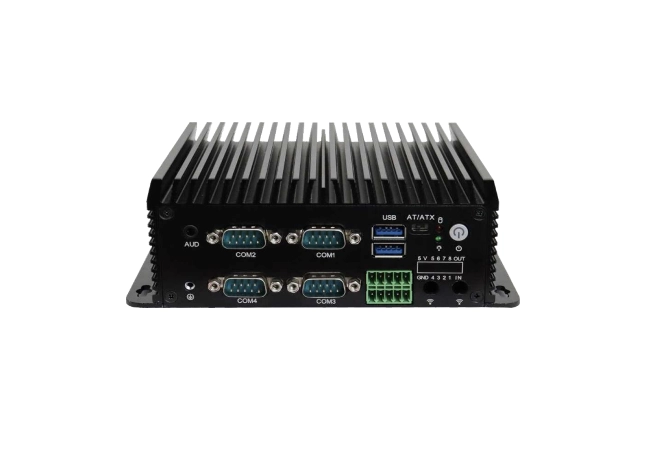
Industrial computing environments demand extensive connectivity. Equipment may need to interact with cameras, sensors, control systems, and communication gateways.
For this reason, industrial computers often include multiple types of interfaces such as serial ports, LAN connections, GPIO interfaces, and additional expansion options. These interfaces enable seamless integration with operational technology systems.
Space limitations also play a role. Many installations occur within cabinets or equipment housings where rack servers cannot easily fit.
Rugged edge computers typically use compact box PC designs that allow flexible mounting options. These systems can be installed on walls, rails, or directly within equipment enclosures.
Because they are positioned close to machines, data can be processed locally without relying entirely on centralized infrastructure. This improves response time and reduces network load.
Integration with industrial cameras, automation systems, and IoT devices becomes easier when computing resources are located near the source of data generation.
In traditional IT environments, maintenance often involves scheduled visits to a server room where technicians can access equipment easily. Components may be replaced quickly without affecting operational processes.
Industrial sites operate differently. A computing system might be installed inside a production line cabinet or remote monitoring station. Access could require halting equipment or traveling to remote locations.
Frequent maintenance becomes impractical in such scenarios.
Rugged computing platforms are built to minimize service requirements. Durable enclosures, fanless cooling, and industrial-grade components reduce the likelihood of hardware failure.
Because these systems require less frequent maintenance, organizations can avoid many unplanned service visits. The result is improved operational continuity and lower long-term maintenance costs.
This reliability is particularly valuable in facilities that operate continuously or across multiple remote sites.
In industrial environments, systems may remain in operation for many years. Hardware consistency across deployments is important because it simplifies maintenance, software updates, and system integration.
Frequent hardware changes can create compatibility issues or require expensive redesigns of software platforms.
High processing power alone does not guarantee operational success. If hardware fails due to environmental conditions or requires frequent maintenance, performance advantages become irrelevant.
A properly designed rugged edge system balances processing capability with environmental durability. It may not always deliver the highest benchmark scores, but it maintains reliable operation over long periods.
This consistency often results in better real-world performance and operational efficiency for industrial applications.
Production lines benefit from rugged systems because computers can be installed directly near inspection cameras or automation equipment. This placement allows data to be processed immediately, improving quality control and operational efficiency.
Remote monitoring sites also benefit from rugged hardware. Environmental monitoring stations, energy facilities, and infrastructure systems often operate in locations where maintenance access is limited.
Transportation systems represent another common use case. Computing equipment installed in vehicles must tolerate vibration, movement, and temperature changes while continuing to process operational data.
Outdoor or semi-outdoor installations require hardware capable of withstanding environmental exposure without relying on climate-controlled rooms.
Standard edge servers can still play an important role in controlled environments. Facilities with dedicated IT rooms, stable airflow, and consistent maintenance access may find rack-mounted servers appropriate for certain workloads.
These environments allow servers to operate under the conditions they were originally designed for.
Choosing between edge computing platforms ultimately depends on where and how the system will operate. In controlled environments, traditional servers may provide sufficient performance. However, when computing must occur directly within operational environments, durability and reliability become critical. Industrial edge computers designed for harsh conditions offer advantages in uptime, maintenance reduction, and deployment flexibility. Vincanwo Group has developed rugged industrial computing solutions used across manufacturing, transportation, and infrastructure sectors, helping organizations deploy stable edge systems close to their operations. If you are planning an industrial edge computing project and want to explore suitable hardware solutions, contact us to learn more about our rugged computing platforms and application support.
Rugged edge computers are used to process data directly near machines, sensors, and industrial equipment. They support applications such as machine vision inspection, predictive maintenance, remote monitoring, and edge AI analytics.
Rugged edge computers are built with stronger enclosures, fanless cooling designs, and industrial-grade components. These features help them withstand dust, vibration, and temperature variation commonly found in industrial environments.
Yes. Many rugged edge computers support GPU acceleration and high-performance processors, enabling real-time AI inference for tasks such as video analytics, defect detection, and automated monitoring.
Organizations should consider rugged edge computers when computing equipment must operate directly on factory floors, outdoor facilities, vehicles, or other environments where temperature, dust, or vibration could affect traditional server hardware.


