
Views: 0 Author: Site Editor Publish Time: 2026-03-19 Origin: Site


Industrial sites generate enormous volumes of data every second. Cameras inspect production lines, sensors monitor equipment performance, and machines continuously report operational status. Transmitting all of this information to centralized cloud systems introduces delay, bandwidth consumption, and potential reliability issues. This is where Rugged Edge Computers become essential. By enabling data processing directly where information is generated, these systems make real-time analytics and edge AI deployment practical in demanding environments. As a high-tech manufacturer specializing in industrial computing hardware since 2008, Vincanwo Group develops edge computing platforms designed to support reliable data processing in manufacturing plants, transportation systems, energy facilities, and other industrial scenarios where dependable performance is critical.
Many organizations successfully develop AI models during laboratory testing or pilot programs. These early experiments demonstrate how machine learning algorithms can identify defects, detect anomalies, or optimize operational processes. However, when the time comes to deploy these systems in real industrial environments, progress often slows down.
Laboratory conditions are typically stable and predictable. Systems operate in clean spaces with reliable connectivity and controlled temperatures. Industrial environments are very different. Equipment must operate in locations where dust, vibration, temperature variation, and electromagnetic interference are common.
Connectivity limitations also become a major factor. Factories and remote sites may not have the high-speed networks required to transmit large volumes of sensor or video data to centralized computing infrastructure.
Another challenge arises from installation constraints. Edge AI systems must often fit into existing equipment cabinets, production lines, or monitoring stations. Space limitations and mounting restrictions can complicate hardware deployment.
These real-world factors explain why many promising AI projects stall before reaching full operational scale.
Artificial intelligence models alone do not create value unless they can operate continuously within production environments. Edge AI solutions require reliable computing hardware that can process data locally, integrate with industrial devices, and operate around the clock without constant maintenance.
Without appropriate hardware infrastructure, organizations may encounter latency issues, excessive network traffic, or unstable system performance. Edge AI deployment therefore requires careful consideration of the computing platforms that will run inference workloads at the operational edge.
Rugged edge computing platforms allow organizations to process information directly at the point of data generation. Instead of sending every data stream to a remote server or cloud platform, analytics tasks can be executed locally.
This approach significantly reduces latency. Real-time analytics becomes possible because the system does not depend on long network paths to process information.
Local data processing also shortens decision cycles. Production systems can respond immediately to detected anomalies or quality issues. Machines may adjust operational parameters automatically when abnormal patterns are identified.
Another benefit is reduced bandwidth consumption. Only processed insights or summarized data need to be transmitted to centralized systems. This lowers the burden on network infrastructure while maintaining operational visibility.
Local analytics capabilities transform how industrial systems operate. Machine vision applications can analyze images directly on the production line to identify defects or verify assembly quality.
Predictive maintenance systems monitor vibration patterns, temperature changes, or electrical signals from equipment. Local processing allows these systems to detect early warning signs of failure before costly breakdowns occur.
Anomaly detection algorithms can identify unusual patterns in sensor data, enabling operators to investigate issues before they escalate into operational disruptions.
Transportation and surveillance systems also benefit from edge processing. Video analytics performed locally enables faster recognition of safety events, traffic conditions, or security incidents.
These applications demonstrate how real-time analytics improves operational efficiency and safety across many industries.
Edge AI workloads require computing platforms capable of handling inference tasks efficiently. This may involve CPUs optimized for industrial computing, GPUs designed for parallel processing, or dedicated AI accelerators.
Selecting the right processing architecture ensures that AI models run efficiently without consuming excessive power or generating unnecessary heat. Industrial deployments often prioritize balanced performance rather than maximum theoretical speed.
Matching computing resources to the specific workload also improves system efficiency. Machine vision inspection may require GPU acceleration, while predictive maintenance analytics may rely primarily on CPU processing.
Appropriate hardware configuration ensures that edge systems deliver consistent performance while maintaining operational stability.
Industrial computing platforms must integrate seamlessly with various devices and communication systems. Cameras, sensors, programmable logic controllers, and network gateways all need reliable connectivity.
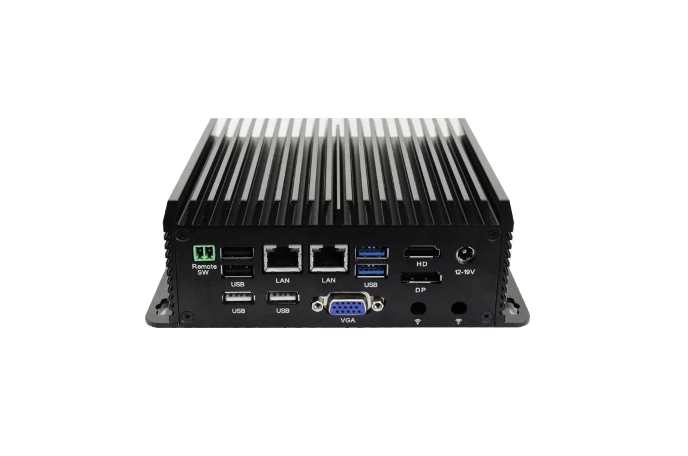
Rugged edge computers typically support multiple LAN interfaces, wireless connectivity options, and expansion modules for specialized applications. This flexibility allows them to serve as central hubs for industrial data collection and processing.
Additional storage capacity may also be required for temporary data retention, especially in environments where network connectivity is intermittent.
Because edge computing systems often act as both processing units and data gateways, connectivity options are critical to successful deployment.
Edge computing hardware must often fit within constrained spaces near operational equipment. Compact industrial computer designs allow systems to be mounted directly within control cabinets or equipment enclosures.
This proximity reduces signal latency and simplifies integration with production systems. Rugged enclosures protect the hardware from environmental exposure while allowing it to operate continuously.
Such designs enable computing platforms to function as integral components of industrial infrastructure rather than separate IT systems.
Quality inspection systems increasingly rely on machine vision and AI algorithms to detect defects during manufacturing processes. Edge computing allows images captured by cameras to be analyzed immediately.
Instead of sending large image datasets to remote servers, rugged edge computers perform inference locally. Results are generated in milliseconds, allowing production lines to remove defective products instantly.
This real-time capability improves product quality while reducing waste and rework costs.
Industrial equipment generates continuous data related to vibration, temperature, electrical load, and other performance indicators. Edge analytics platforms analyze this data locally to detect abnormal conditions.
Predictive maintenance systems powered by edge computing can alert operators before failures occur. Early detection allows maintenance teams to schedule repairs without interrupting production schedules.
This proactive approach improves equipment reliability and extends operational lifespan.
Video surveillance systems increasingly rely on AI algorithms to detect safety hazards, monitor operations, or track asset movement. Processing video streams locally reduces bandwidth requirements while enabling faster event detection.
Edge AI systems analyze video data directly within industrial sites, identifying important events such as unauthorized access, unsafe worker behavior, or equipment malfunctions.
Immediate alerts allow organizations to respond quickly to potential risks.
Many industrial facilities operate in remote locations where network infrastructure is limited. Energy installations, transportation networks, and environmental monitoring stations often rely on intermittent connectivity.
Edge computing platforms enable these sites to continue processing data even when network connections are unavailable. Only essential information is transmitted once connectivity is restored.
This approach ensures operational continuity and reduces dependence on constant cloud connectivity.
Factor | Cloud-First AI Workflow | Rugged Edge AI Workflow |
Data path | Data sent to centralized cloud servers | Data processed locally at the edge |
Latency | Higher due to network transmission | Very low due to local processing |
Bandwidth use | High bandwidth consumption | Reduced bandwidth requirements |
Response speed | Delayed responses possible | Immediate local response |
Connectivity dependency | Continuous network required | Can operate with limited connectivity |
Mission-critical suitability | Less suitable for time-sensitive operations | Ideal for real-time industrial systems |
Edge AI deployments depend on continuous operation. If the computing platform running AI inference fails, the entire analytics workflow can be disrupted.
Production lines may lose inspection capabilities. Monitoring systems may stop detecting anomalies. Safety alerts may no longer function properly.
These disruptions highlight the importance of reliable hardware infrastructure in edge AI systems.
Industrial environments place continuous stress on computing equipment. Dust accumulation, vibration from machinery, and temperature variation can affect system stability.
Power fluctuations and electrical noise may also influence system performance. Rugged hardware design helps mitigate these challenges.
Industrial computing platforms built for edge environments typically incorporate sealed enclosures, durable components, and thermal management systems designed for continuous operation.
These design features allow systems to run reliably in environments where conventional IT hardware might struggle.
Organizations adopting edge AI solutions often focus on performance improvements such as faster analytics and reduced latency. However, additional benefits also contribute to long-term value.
Local processing reduces the amount of data transmitted across networks. This lowers bandwidth costs and improves operational efficiency.
Stable hardware platforms also support continuous operations. Reduced downtime means fewer interruptions to production activities.
Another advantage is easier deployment. Compact industrial computing systems can be installed directly within operational environments without requiring specialized server infrastructure.
Pilot AI projects often demonstrate strong potential but struggle to transition into full-scale industrial deployment. One major barrier is the lack of reliable computing infrastructure capable of supporting AI workloads continuously.
Rugged computing platforms provide the stability required to operate AI models within real industrial environments. Their durability and flexible installation options enable organizations to deploy edge analytics systems across multiple sites.
As AI adoption expands, scalable edge computing infrastructure becomes increasingly important for long-term success.
Edge AI deployment succeeds only when computing infrastructure is capable of operating reliably where data is generated. Real-time analytics depends on stable hardware platforms that can process information locally while withstanding the environmental challenges of industrial sites. Industrial edge computers designed for durability and continuous operation provide the foundation required for scalable edge AI solutions. Vincanwo Group develops rugged computing platforms that enable organizations to deploy reliable edge analytics systems across manufacturing, transportation, and infrastructure environments worldwide. If your organization is planning to implement real-time analytics or expand edge AI deployment, contact us to explore industrial computing solutions designed for demanding operational environments.
Rugged edge computers run AI inference directly at the location where data is generated. This allows organizations to perform real-time analytics without sending large volumes of information to centralized cloud systems.
Real-time analytics requires low latency and continuous operation. Rugged edge computers provide reliable performance in industrial environments where temperature variation, vibration, and dust could affect standard hardware.
Yes. Many rugged edge computing platforms support GPUs or AI accelerators that enable high-speed image analysis for quality inspection, automated monitoring, and defect detection on production lines.
These systems are built with durable enclosures, stable thermal designs, and industrial-grade components. This allows them to run AI workloads continuously even in demanding environments such as factories, transportation systems, and remote infrastructure sites.


