
Views: 0 Author: Site Editor Publish Time: 2026-10-27 Origin: Site


Field operations are inherently demanding, pushing both personnel and equipment to their absolute limits. Picture a utility technician trying to restore a local power grid during a freezing downpour. Suddenly, their commercial-grade screen goes black, shutting down entirely due to temperature extremes. Professionals working outside traditional office boundaries face unpredictable weather, remote locations, and an unyielding demand for real-time data synchronization. Relying on fragile consumer technology in these unforgiving settings frequently results in catastrophic hardware failure. A shattered screen mid-shift triggers costly operational downtime, unrecoverable data loss, and deeply frustrated frontline teams. The definitive solution lies in deploying specialized hardware. Upgrading to a Rugged Android Tablet serves as the ultimate strategy to bridge the communication gap between centralized headquarters and frontline personnel.
Recent market analyses reveal a massive structural shift in how industries manage mobile workforces. Driven by the rapid expansion of edge computing and industrial automation, companies are aggressively moving away from standard consumer devices. Field engineers now require continuous access to complex schematics, augmented reality overlays, and real-time diagnostic tools right at the job site. Consequently, the demand for purpose-built mobility solutions is surging. Organizations realize that standard electronics act as a severe bottleneck, unable to support advanced digital workflows in extreme environments. This industry-wide transition underscores a simple truth. Investing in specialized field hardware is no longer an optional upgrade, but a fundamental requirement for maintaining competitive operational efficiency.
Durability Equals Uptime: Purpose-built devices are engineered to rigorous military standards like MIL-STD and feature high Ingress Protection ratings, virtually eliminating downtime caused by accidental drops, water exposure, or dust infiltration.
The Android Advantage: The Android operating system provides unparalleled software flexibility, open-source application integration, and seamless Mobile Device Management compatibility for enterprise IT departments.
Uninterrupted Productivity: Advanced capabilities such as hot-swappable batteries, integrated hardware barcode scanners, and robust connectivity keep mobile workers efficient regardless of their physical location.
Superior ROI: Despite a higher initial procurement cost, industrial tablets deliver a significantly better Return on Investment and lower Total Cost of Ownership compared to the constant replacement cycle of fragile consumer alternatives.
Industry Versatility: From utility grid maintenance and construction site management to warehouse logistics, these devices seamlessly adapt to highly specialized and physically demanding industry workflows.
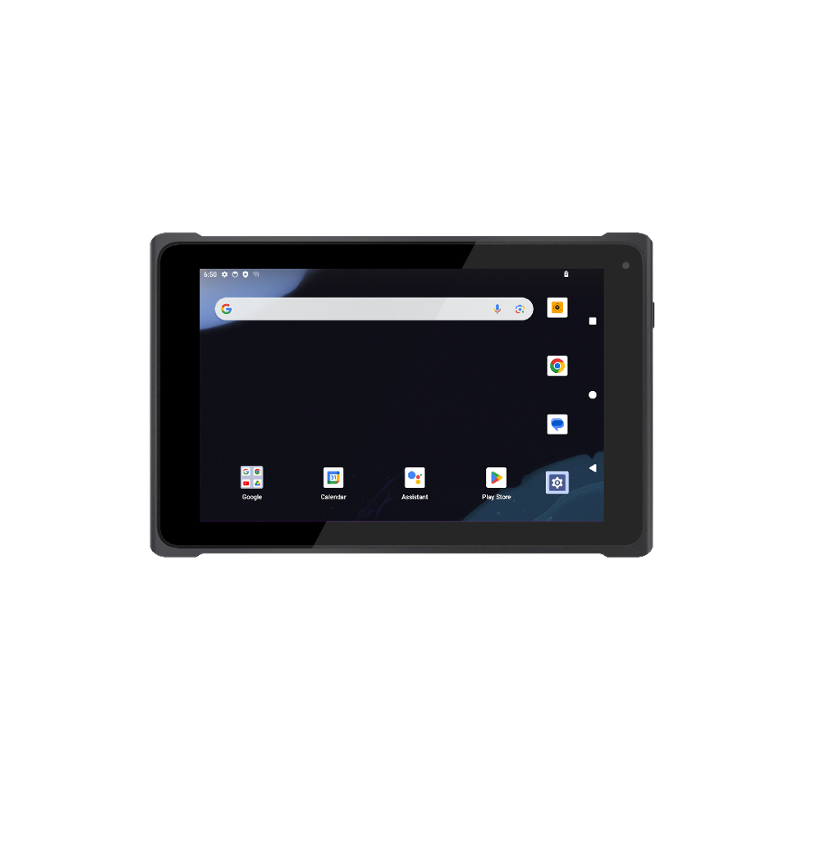
To truly understand the value proposition, procurement teams must evaluate hardware across strict industrial metrics rather than standard consumer benchmarks.
Feature | Consumer Tablet | Industrial Android Tablet |
|---|---|---|
Chassis & Drop Resistance | Plastic or thin metal, shatters at 3-foot drops | Magnesium-alloy, shock-mounted, certified for 4 to 6-foot drops onto concrete |
Ingress Protection | None or basic splash resistance | IP65 to IP68 rating, fully dust-tight and submersible in water |
Screen Visibility & Touch | 300 to 400 nits, highly reflective, fails when wet | 800+ nits, anti-glare, operates flawlessly with heavy gloves and rainwater |
Lifecycle & TCO | 1 to 2 years, high replacement and downtime costs | 5 to 7 years, significantly lower Total Cost of Ownership |
Connectivity | Standard Wi-Fi and basic LTE | Dedicated GNSS, Wi-Fi 6, advanced 4G/5G antennas for dead zones |
Working outside a climate-controlled office introduces a complex matrix of variables. Standard technology simply collapses under these physical pressures. Understanding these logistical hurdles is the first step in optimizing field mobility.
Technicians routinely face severe conditions that destroy off-the-shelf electronics. Commercial tablets typically operate strictly between 32°F and 95°F. In stark contrast, field tasks often occur during intense summer heatwaves or inside environments saturated with airborne particulates like concrete dust. Furthermore, the blinding glare of the midday sun renders standard glossy screens completely unreadable. Mechanics are forced to abandon their tasks and seek shade just to input basic data, severely dragging down momentum.
Maintaining secure communication in subterranean industrial areas remains a significant logistical hurdle. Consumer units feature weak internal antennas that drop signals the moment a worker steps into a dense concrete warehouse. Without reliable connectivity, dispatchers instantly lose real-time visibility of their mobile assets, leading to cascading operational delays.
The financial consequences of fragility are staggering. Dropping a standard tablet onto a concrete slab shatters the interface instantly. This single event triggers a chain reaction. Unsaved local data vanishes, worker productivity halts completely, and IT departments burn critical resources procuring and shipping replacement units to the job site.
A truly industrial device is not merely a standard tablet wrapped in a thick aftermarket rubber case. It is engineered from the motherboard outward for absolute survival. Specifically, devices like the 8-inch Slim Rugged Android Tablet T89 showcase how modern engineering balances extreme protection with ergonomic design.
Ingress Protection defines a unit's resistance to foreign bodies. An IP67 or IP68 rating ensures the hardware remains completely dust-tight and survives temporary full immersion in water. This guarantees functionality even if the unit is accidentally dropped into a flooded trench. Coupled with rigorous military testing standards, these units survive extreme transit drops directly onto plywood over concrete. They also withstand the high-frequency mechanical vibration essential for forklift mounting.
Screen visibility is paramount for outdoor efficiency. Industrial panels push extreme brightness levels, often exceeding 800 nits, utilizing specialized anti-glare optical bonding. Beyond visual clarity, the capacitive touchscreens feature advanced digitizers. A site engineer can operate the interface flawlessly while wearing heavy leather work gloves or when the screen is soaked in rainwater.
When selecting a software ecosystem, Android has firmly established itself as the dominant enterprise standard. Its inherent adaptability and robust security infrastructure make it the logical choice for industrial deployment.
The open-source architecture offers unmatched flexibility. Businesses avoid restrictive proprietary app stores, easily developing custom Android Package Kits tailored exactly to their workflows. Additionally, IT administrators leverage Mobile Device Management software to execute zero-touch enrollments, enforce strict security policies, and remotely wipe sensitive data if a unit is compromised in the field.
Deploying specialized hardware directly translates to measurable productivity gains. By removing technical friction, these devices optimize daily workflows through several specific mechanisms.
Relying on a standard camera lens to scan a mud-splattered barcode in a dimly lit warehouse is incredibly slow. Industrial solutions feature dedicated 1D and 2D hardware scan engines. These specialized scanners read damaged or distant barcodes in milliseconds. Combined with RFID readers, these tools streamline inventory management effortlessly and provide indisputable proof of delivery.
Power loss halts work immediately. Rugged devices address this vulnerability with high-capacity batteries designed to outlast grueling 12-hour shifts. Many incorporate hot-swappable battery technology. A small internal bridge battery keeps the processor powered while the main depleted battery is removed and replaced. This permits a utility worker to swap power sources mid-shift without ever closing their active mapping application.
Standard consumer GPS relies on cellular network triangulation, failing miserably in remote areas. Enterprise units integrate dedicated Global Navigation Satellite System modules communicating directly with multiple satellite constellations. This hyper-accurate location data enables workers to optimize travel routes through complex terrain, saving fuel and valuable time.
Procuring the correct hardware requires moving beyond abstract specifications and matching features directly to frontline realities. Keep these critical factors in mind during your next fleet upgrade.
Assess the Primary Environment: If your team works in warehousing, an IP65 rating with strong vibration resistance is sufficient. For outdoor construction or offshore energy, mandate IP67 or IP68 ratings and extreme temperature tolerances.
Evaluate Screen Requirements: Do not compromise on screen brightness. Ensure the device offers at least 800 nits and glove-touch capability to prevent workflow interruptions in direct sunlight.
Form Factor vs. Performance: Legacy rugged devices were notoriously bulky. Today, modern solutions provide military-grade protection in a slim profile. Prioritize lightweight ergonomics to reduce worker fatigue during extended shifts.
Verify Connectivity: Ensure the device supports the specific peripherals your team uses, robust Wi-Fi 6 antennas, and dedicated cellular modems to prevent data bottlenecks in remote areas.
The structural resilience of these devices makes them indispensable across physically demanding sectors.
Technicians perform grid inspections and substation diagnostics in brutal weather. Devices deployed to remote solar arrays must withstand constant exposure to extreme temperatures and high winds. Industrial hardware allows these workers to render heavy Computer-Aided Design files directly on the site without fear of cement dust compromising the internal circuitry.
Supply chain efficiency relies entirely on speed. In warehousing, ruggedized Android tablet solutions are frequently mounted onto forklifts, enduring constant mechanical vibration and sudden temperature shifts inside cold storage. Truck drivers utilize them as reliable Electronic Logging Devices to track hours of service and capture digital signatures at loading docks.
For procurement officers, budget allocation is a primary concern. Purchasing decisions based solely on upfront costs invariably lead to inflated long-term expenses.
The real expense of a consumer device lies in hidden failure costs. When a fragile tablet breaks, the company incurs IT support tickets, hardware replacement, and lost localized data. Most critically, a highly paid technician unable to work represents a direct loss of revenue that vastly exceeds the initial price difference between commercial and industrial hardware.
Consumer technology is designed with planned obsolescence, requiring total replacement every 12 to 24 months. Conversely, industrial tablets are engineered for extended lifecycles, routinely operating in harsh field conditions for 5 to 7 years. This extended deployment cycle drastically reduces procurement frequency, resulting in a remarkably stronger Return on Investment.
Upgrading your mobile device fleet is a strategic necessity for any business managing a distributed workforce. Relying on fragile consumer devices in harsh environments is a gamble that ultimately costs organizations thousands in lost productivity. A reliable, purpose-built device directly translates to faster job completion, enhanced data accuracy, and elevated employee satisfaction.
The combination of software flexibility, military-grade hardware durability, and specialized data capture tools ensures your frontline team remains connected and efficient. If you are looking to eliminate costly downtime and empower your workers, evaluate your current mobility strategy today. Explore the full range of high-performance devices at Vincanwo Group to find the perfect Rugged Android Tablet tailored to your specific operational needs.
A true industrial-grade unit is engineered to last between 5 to 7 years, even when deployed in harsh outdoor environments. This contrasts sharply with the 1 to 2-year lifespan typical of standard consumer tablets used in similar conditions.
Unlike commercial electronics that shut down in freezing or blistering conditions, purpose-built field devices feature specialized thermal management systems, insulated batteries, and industrial-grade internal components. This allows them to operate flawlessly in temperatures ranging from -4°F to over 140°F.
An IP65 rating means the device is completely dust-tight and protected against low-pressure water jets, making it suitable for indoor warehousing or light rain. An IP67 rating ensures the device can survive temporary full immersion in water, which is critical for outdoor construction sites, utility trenches, and marine environments.
Yes. Because they run on the open Android operating system, they are highly compatible with custom enterprise applications, proprietary field service management software, and the broader Google Play ecosystem.
Not anymore. Modern engineering solutions provide military-grade drop and water protection while maintaining a slim, lightweight, and ergonomic profile. This ensures all-day portability without causing worker fatigue.
A hot-swappable system contains a small internal backup battery that keeps the device running for a few minutes while the main depleted battery is physically removed and replaced. This allows for continuous operation without ever having to power down the tablet or close active applications.


