
Views: 0 Author: Site Editor Publish Time: 2026-10-27 Origin: Site


The rapid evolution of Industry 4.0 transforms modern manufacturing facilities daily. Operations demand smarter edge computing. AI-driven automation requires unprecedented computing power to maintain operational efficiency. But where does this processing happen? It must exist right on the active, chaotic factory floor. Standard commercial computers fail quickly under these notoriously harsh environmental conditions. Airborne dust clogs cooling fans. Extreme temperatures melt consumer-grade components. Constant machinery vibration destroys spinning hard drives. This inevitable system downtime costs thousands of dollars per hour. To solve this critical vulnerability, an Industrial Box PC serves as the ultimate hardware solution. It perfectly bridges the gap between rugged physical durability and high-end processing capabilities.
Key Takeaways
Unmatched Durability: Specialized computers utilize fanless designs and sealed enclosures to survive extreme temperatures, shocks, and heavy vibrations.
Next-Gen Performance: Modern embedded systems leverage cutting-edge silicon to handle complex edge AI and machine vision tasks without latency.
Versatile Applications: These highly adaptable units serve strict medical compliance standards and heavy manufacturing needs through extensive hardware customization.
Lower Total Cost of Ownership: Extended hardware lifecycles and zero-maintenance architectures result in massive long-term financial savings.
Recent engineering analyses reveal a massive shift in manufacturing IT architecture. Centralized cloud processing is no longer sufficient for real-time automation. Sending terabytes of high-resolution inspection data to a remote server introduces unacceptable latency. Automated optical inspection requires microsecond decision-making. Consequently, the industrial market is aggressively moving toward decentralized edge nodes. Facilities now deploy high-performance computing hardware directly at the machine level. This localized processing secures proprietary production data. It also guarantees uninterrupted automated operations even during severe network outages.
Historically, factory computing meant simple data logging. It meant basic programmable logic controller management. That paradigm is completely dead. Today's industrial computers act as highly capable edge servers. Engineers design them to execute complex algorithms right where data generates. By processing massive datasets from IoT sensors locally, these systems minimize reliance on fragile cloud infrastructure. This drastically reduces network latency and enhances data security for critical real-time factory operations.
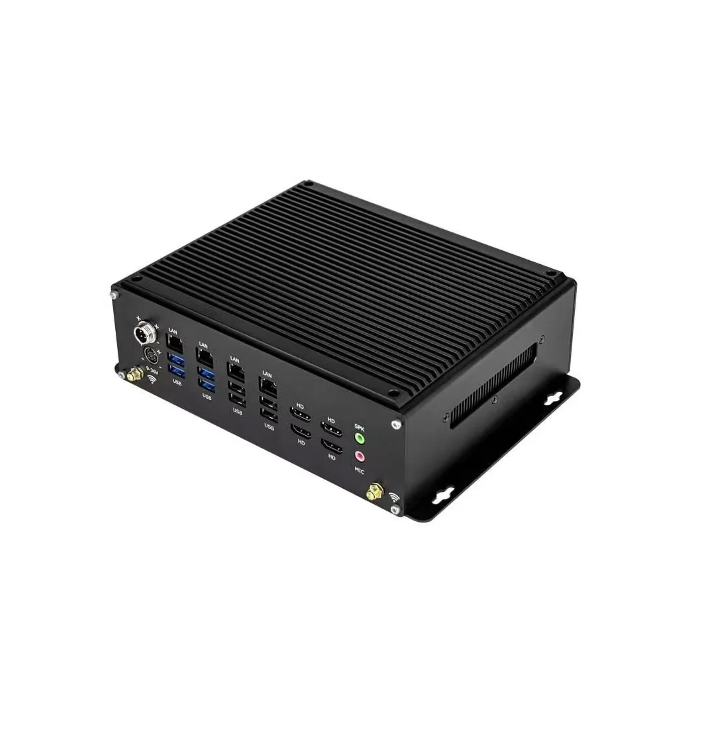
Standard systems rely on active cooling fans. These fans inevitably suck metallic shavings, corrosive particulates, and dust straight into sensitive motherboards. Advanced industrial models eliminate this critical flaw entirely. They utilize a completely fanless and cableless internal architecture. Extruded aluminum heat sinks dissipate thermal energy passively. Engineers solder components directly to the printed circuit board. This eliminates internal cables that always fail under mechanical wear and tear.
Factory floors feature a complex mix of legacy iron alongside cutting-edge sensors. Seamless integration requires rich I/O connectivity. Rugged computers feature multiple COM ports for older legacy controllers. They include dual Gigabit LAN for network redundancy. Digital I/O allows direct actuator control. This ensures perfect compatibility without relying on fragile external USB adapters.
Commercial towers belong in climate-controlled offices. They survive only between 10 degrees and 35 degrees Celsius. Heavy manufacturing demands more. An industrial embedded system survives extreme thermal stress. You can deploy it inside a freezing commercial storage warehouse. You can mount it mere feet from a scorching foundry furnace. These robust units operate reliably from negative 20 degrees up to 70 degrees Celsius. Furthermore, wide voltage inputs protect the system against dangerous power spikes common during heavy machinery startup sequences.
Robotic arms and automated guided vehicles generate relentless kinetic energy. This continuous vibration rattles standard spinning hard drives to the point of failure. Ruggedized chassis designs protect internal electronic components from severe physical damage. By utilizing solid-state drives and secure internal mounting blocks, engineers ensure flawless operation despite the heavy vibrations occurring on the busy production line.
Airborne particulates constantly threaten sensitive circuitry. Sealed metal enclosures provide exceptionally high levels of physical ingress protection. Specific IP ratings guarantee excellent defense against fine dust and low-pressure water jets. This specialized engineering prevents electrical short circuits during daily industrial washdowns. It significantly extends the overall functional lifespan of the computing device.
Feature / Specification | Standard Commercial PC | Advanced Industrial Box PC |
|---|---|---|
Cooling Mechanism | Active fans prone to dust clogging | Fanless passive extruded aluminum heatsinks |
Operating Temperature | 10 to 35 Degrees Celsius | -20 to 70 Degrees Celsius |
Vibration Resistance | Low fails easily under kinetic stress | High MIL-STD tested cableless design |
Lifecycle Availability | 1 to 3 years max | 5 to 10 years embedded roadmap |
Modern automation relies heavily on complex artificial intelligence algorithms. Tasks such as automated optical inspection and predictive maintenance require massive parallel processing power. Integrating dedicated graphics units changes the game entirely. A high-performance rugged embedded computer analyzes high-resolution image streams instantly on fast-moving assembly lines. This ensures manufacturing processes remain highly efficient and virtually error-free.
To meet these rigorous demands, manufacturers integrate the latest enterprise-grade silicon into ruggedized formats. Let us examine real-world hardware parameters. Systems utilizing configurations like the VB-5714 represent the pinnacle of current edge hardware. By leveraging an Intel 14th Core i5-14450HX processor combined with an AMD Vega 4GB GPU, engineers unlock unprecedented multi-threading capabilities. This sophisticated silicon architecture runs parallel automation software effortlessly. The dedicated 4GB graphics memory handles the complex matrix multiplications required for deep learning inference. Most importantly, the hardware achieves this dense computational output without experiencing dangerous thermal throttling inside enclosed control cabinets.
Embedded computers act as the central nervous system for smart factories. They interface directly with motion controllers and environmental sensors to aggregate production data in real time. By running manufacturing execution systems and coordinating multiple robotic arms seamlessly, these units enable dynamic assembly lines. The production floor automatically adjusts to different product configurations without any human intervention.
The healthcare sector demands hardware that meets strict regulatory compliance. Medical certifications mandate specific electrical isolation to protect patients. Beyond safety, these systems power advanced diagnostic equipment like MRI and CT scanners. High-performance processors swiftly render complex 3D anatomical models. The fanless design proves crucial in sterile operating theaters. It prevents the dangerous circulation of airborne pathogens during surgical procedures.
Railway networks and maritime operations face highly unpredictable environments. Modern in-vehicle systems rely heavily on fast 5G cellular connectivity and integrated GPS for accurate fleet logistics. Consequently, these rugged units possess strict anti-vibration certifications. They also feature intelligent ignition power management. This critical feature prevents draining the vehicle battery during complex startup and shutdown sequences.
Off-the-shelf products often fall short when addressing the nuanced requirements of complex business applications. Industrial projects frequently involve unique spatial constraints or niche operating system dependencies. Customization ensures the hardware perfectly aligns with the intended physical environment. Engineers modify internal components and optimize specific software performance metrics without resorting to fragile external workarounds.
Partnering with a manufacturer for original equipment manufacturer solutions provides distinct strategic benefits. Businesses specify exact I/O layouts. For instance, an engineer might add extra CAN bus ports specifically for automotive testing. You can customize physical form factors to fit inside incredibly tight control cabinets. Because industrial deployments evolve, modular computer designs offer incredible scalability. Accessible expansion slots allow technicians to easily upgrade wireless connectivity or insert specialized AI accelerator cards as operational needs expand.
Selecting the correct computational power is the first critical step. Do not guess. Match the silicon to the software load. For basic environmental monitoring, energy-efficient processors remain highly effective. However, for demanding real-time AI inference or multi-camera machine vision, high-performance CPUs are absolutely mandatory. Exploring an advanced Industrial Box PC solution ensures your system has the necessary multi-core architecture to handle complex algorithms without frustrating bottlenecks.
Before final procurement, project engineers must conduct a thorough physical space assessment. Measure ambient temperature extremes. Identify potential exposure to cutting fluids or corrosive metallic dust. Verify your mounting options. Ensure you select the correct DIN-rail clips for standard cabinets or VESA brackets for flat surfaces. This ensures the physical dimensions and thermal dissipation requirements align perfectly with your deployment area.
In the consumer electronics market, a two-year product lifecycle is standard. In industrial automation, such rapid turnover is financially unacceptable. Software recertification costs are simply too high. Therefore, it is imperative to choose industrial-grade components featured on official embedded roadmaps. This guarantees hardware availability for five to ten years. This strategy prevents premature obsolescence and simplifies future maintenance across your entire facility.
Procurement managers often face sticker shock when comparing industrial PCs to commercial alternatives. Evaluating the investment solely based on the initial purchase price is a flawed metric. A premium industrial system requires a higher upfront investment. However, it drastically reduces the total cost of ownership over time. You eliminate the frequent replacement costs and active maintenance associated with standard desktop computers.
In heavy manufacturing, unexpected factory downtime easily exceeds tens of thousands of dollars per hour. If a commercial PC managing a critical assembly line fails due to thermal throttling, the entire production process halts immediately. The continuous reliability of a fanless ruggedized computer acts as an insurance policy. By ensuring constant uptime, these reliable systems protect production schedules and ultimately safeguard the company bottom line.
Unlocking high performance in harsh environments requires abandoning fragile commercial hardware. Standard computers simply cannot survive the demanding conditions of modern factory floors. Integrating powerful next-generation processors like the Intel 14th Core i5 and robust dedicated AMD graphics expands edge computing possibilities to unprecedented levels. We encourage facility managers to evaluate their current infrastructure immediately. Explore the high-performance Industrial Box PC setups available at Vincanwo Group to future-proof your operations. Secure unmatched reliability and exceptional processing capabilities for years to come.
Industrial models feature fanless designs and rugged metal casings completely devoid of internal moving parts. They are specifically engineered to tolerate wide temperature ranges and resist heavy physical vibrations easily. Standard desktops use active cooling fans and plastic chassis. They fail rapidly when exposed to harsh industrial environmental conditions.
This depends entirely on your specific software application. Simple data logging does not require a dedicated graphics processing unit. Modern applications like machine vision, automated optical inspection, and complex medical imaging benefit greatly from them. Advanced AI inference tasks process much faster and more efficiently with a robust GPU installed.
These rugged computers boast an extended mean time between hardware failures. Industrial-grade components typically offer a highly reliable five to ten-year lifecycle supported by long-term embedded roadmaps. Commercial computers usually require replacement every two to three years.
Yes. Leading manufacturers offer extensive original equipment manufacturer customization services. Businesses can request custom I/O configurations, specialized internal expansion slots for proprietary cards, and unique chassis branding. Suppliers can also deliver systems with pre-configured specialized operating systems installed right out of the box.
Not at all. These compact computers offer highly versatile and simple physical mounting options designed for industrial settings. Technicians can utilize DIN-rail mounts for control cabinets, standard VESA mounting brackets for attaching behind monitors, or simple wall mounts. This flexibility makes them remarkably easy to integrate into incredibly tight spaces.
Programmable logic controllers are purpose-built for executing specific rigid control logic with extreme reliability. Industrial computers offer broader versatility. They run full operating systems like Windows or Linux. This allows them to handle complex tasks like database management, high-speed machine vision, and advanced human-machine interfaces alongside basic control functions.
Fanless systems utilize advanced passive cooling engineering. The outer metal chassis acts as a giant heat sink. Internal heat-generating components like the CPU connect directly to this aluminum casing via thermal pads. The fins on the exterior dissipate the thermal energy into the surrounding air naturally. This completely eliminates the need for mechanical cooling fans.


